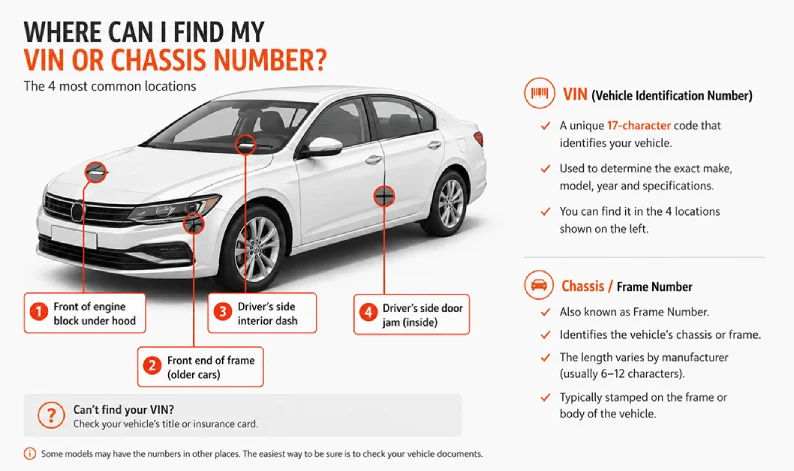
When searching for a replacement car part, you will often encounter combinations of letters and numbers such as:
42410-30021
51686-TBA-A01
13323AA031
These are automotive part numbers. They are one of the most accurate ways to identify a specific component, but they can be confusing if you do not know how automotive manufacturers use them.
An OEM part number can help distinguish between components that look almost identical, identify updated or superseded parts, and dramatically reduce the risk of ordering the wrong replacement.
However, there is one important rule to understand from the beginning:
There is no universal OEM part-number format used by every vehicle manufacturer.
Toyota, Honda, Nissan, Subaru, Mazda, Mitsubishi and other manufacturers each maintain their own numbering systems.
Understanding how part numbers work — and how they should be used — is therefore more useful than trying to apply one universal decoding formula.
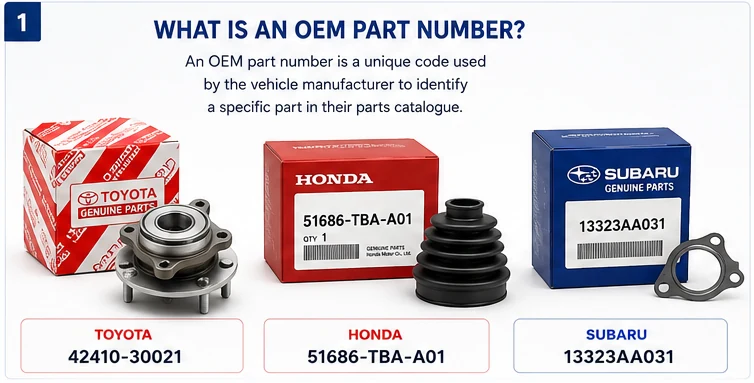
An OEM part number is a unique reference used within a vehicle manufacturer’s parts catalogue to identify a particular component or component specification.
Instead of searching for:
Honda front shock absorber dust cover
you can search for:
Honda 51686-TBA-A01
The second search is much more precise.
A vehicle can contain thousands of individual components. Many of them may have similar names, and some may look almost identical while having important differences in dimensions, connectors, mounting points, materials or vehicle application.
The part number gives each component an identifiable reference within the manufacturer’s parts system.
Several terms are commonly used when discussing automotive parts, and they are sometimes used interchangeably.
OE means Original Equipment.
It generally refers to components manufactured for installation on a vehicle as part of its original production.
OEM means Original Equipment Manufacturer.
Strictly speaking, an OEM is a manufacturer involved in producing original equipment. However, in the automotive parts trade, the term OEM part number is also widely used to describe the vehicle manufacturer’s catalogue reference for a component.
A genuine replacement part is normally supplied through the vehicle manufacturer’s official branded parts system.
Examples include:
Genuine Toyota Parts
Genuine Nissan Parts
Genuine Honda Parts
Genuine Subaru Parts
A genuine part normally carries the vehicle manufacturer’s official service part number.
The company that physically manufactures the component, however, is not necessarily the company whose name appears on the vehicle.
Vehicle manufacturers use large networks of specialist suppliers to manufacture many original components.
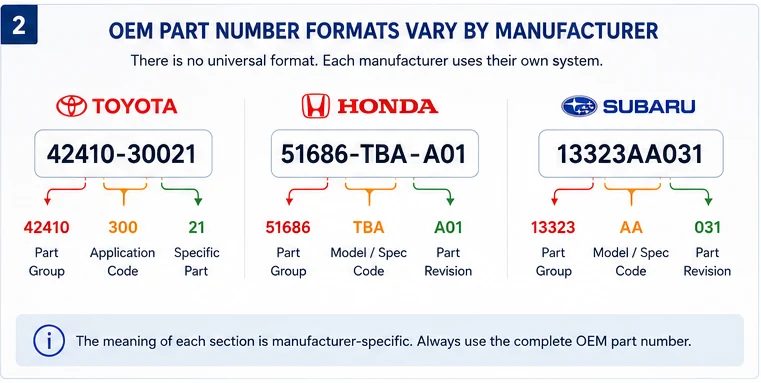
Part-number formats vary significantly between manufacturers.
For example:
|
Manufacturer |
Example Part Number |
|
Toyota |
42410-30021 |
|
Honda |
51686-TBA-A01 |
|
Subaru |
13323AA031 |
At first glance, all three numbers look quite different.
Toyota commonly uses part numbers presented in groups separated by a hyphen.
Honda uses a different alphanumeric format.
Subaru frequently uses compact combinations of digits and letters without hyphens.
This illustrates why there is no universal method for decoding every automotive part number.
No.
A common mistake is to assume that automotive part numbers work like VINs, where an international framework defines the overall structure.
OEM part numbers are different.
Each vehicle manufacturer maintains its own catalogue and numbering conventions.
A particular group of digits may have meaning within Toyota’s parts system but tell you nothing useful about a Honda or Subaru part.
Even within one manufacturer, the interpretation of every character should not be guessed without reliable catalogue information.
The safest approach is to treat the complete part number as the identifier.
Hyphens are often used to make a manufacturer’s part-number format easier to read.
For example:
51686-TBA-A01
may also appear in databases as:
51686TBAA01
Similarly:
42410-30021
may appear as:
4241030021
In many catalogue and ecommerce systems, punctuation is removed when part numbers are stored, searched or included in URLs.
The underlying reference can still represent the same manufacturer part number.
This is why, when searching for an automotive part online, it can be useful to try both versions:
51686-TBA-A01
and
51686TBAA01
Search engines and parts databases are generally good at recognizing these variations, but not every database stores part numbers in the same format.
Sometimes — but only within the numbering system used by the relevant manufacturer.
A manufacturer may use different sections of a part number to represent information such as:
However, the exact meaning varies.
It is therefore risky to assume that two parts are interchangeable simply because a section of their numbers matches.
The complete part number should always be checked.
Consider two example part numbers:
12345-ABC-010
12345-ABC-020
Only one section is different.
It may be tempting to assume that they are effectively the same part.
That difference, however, could potentially represent:
A small difference in a part number can therefore represent a significant physical or functional difference.
Similar part number does not automatically mean compatible part.
Depending on the manufacturer, a part number may contain different sections that function as prefixes, central identifiers or suffixes.
A suffix is particularly easy to overlook.
For some components, a suffix can identify a specific variation of the basic part.
This is especially important with:
For example, two interior components may have the same basic design but different colour or trim specifications.
Removing the suffix when ordering could result in receiving a part that physically fits but is visually incorrect.
The meaning of a suffix is manufacturer-specific, so it should not be interpreted using rules from another brand.
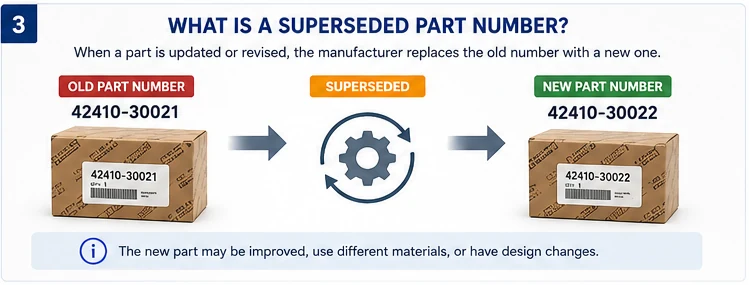
Cars remain in service for many years, but their components do not necessarily remain unchanged.
Manufacturers regularly revise replacement parts.
When an older part number is officially replaced by a newer part number, this is commonly called a part-number supersession.
The relationship can look like this:
Original Part Number → Superseded By → New Part Number
A supersession can happen for many reasons.
The manufacturer may have:
The old number may therefore disappear from current stock even though a valid replacement remains available under a newer number.
Not necessarily.
Sometimes the replacement is effectively the same component under a newer reference.
In other cases, the manufacturer may have made a physical or engineering change.
What matters is that the manufacturer has established the newer part as the appropriate service replacement for the relevant application.
This is why a reliable parts catalogue is more useful than simply comparing photographs.
A new component may look slightly different and still be the correct official replacement.
Yes.
A component may be revised more than once during a vehicle’s lifetime.
For example:
Part A → Part B → Part C → Current Part D
A customer searching for the original number may therefore find very little current stock.
Searching the supersession chain may reveal that the manufacturer now supplies the component under a completely different number.
This is particularly important when sourcing parts for older vehicles.
Yes.
A manufacturer does not necessarily design a unique component for every vehicle model.
The same part may be shared between:
If the manufacturer assigns the same service part number to those applications, one genuine component may therefore fit several different vehicles.
This is one reason why searching by exact OEM number can be more precise than searching by vehicle model alone.
There are several places where a part number may be found.
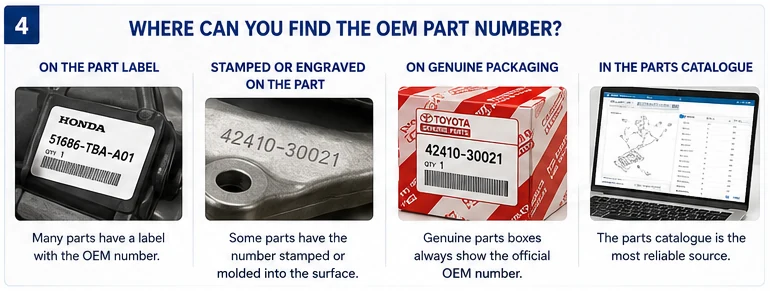
Many automotive components have identifying numbers printed, stamped, engraved or moulded into them.
Common examples include:
However, you should not automatically assume that every number visible on a component is the OEM service part number.
Electronic and mechanical components frequently have labels containing identifying information.
A label may contain:
Care must be taken to identify which number is actually the service part number.
Genuine manufacturer packaging normally carries a product label.
The label commonly includes the official service part number together with information such as:
For a new genuine replacement part, the packaging label is often one of the clearest places to confirm the part number.
A manufacturer’s electronic parts catalogue is one of the most reliable ways to determine the correct service part number
The vehicle is first identified, often using its VIN or chassis information.
The catalogue can then show the components associated with that vehicle specification.
This is extremely important.
A component may contain several different numbers.
For example, you might find:
OEM service part number
supplier number
engineering number
casting number
mould number
serial number
batch number
production date code
These numbers perform different functions.
A casting number may identify the casting from which several different finished components are produced.
A supplier number may identify the component within the supplier’s own catalogue.
A serial number may identify one individual unit.
None of these necessarily represents the vehicle manufacturer’s replacement part number.
You may also encounter the term MPN, meaning Manufacturer Part Number.
In ecommerce systems, MPN is commonly used as a field for the manufacturer’s identifying number for a product.
For genuine automotive parts, this may be the same number that the vehicle manufacturer uses in its service parts catalogue.
However, terminology can become more complicated when a specialist supplier also has its own number for the component.
For example, one component might potentially have:
Vehicle manufacturer reference
and
Component supplier reference
Both can be valid manufacturer numbers, but they belong to different catalogue systems.
For genuine vehicle parts, the vehicle manufacturer’s service part number is usually the most useful reference when searching the manufacturer’s catalogue.
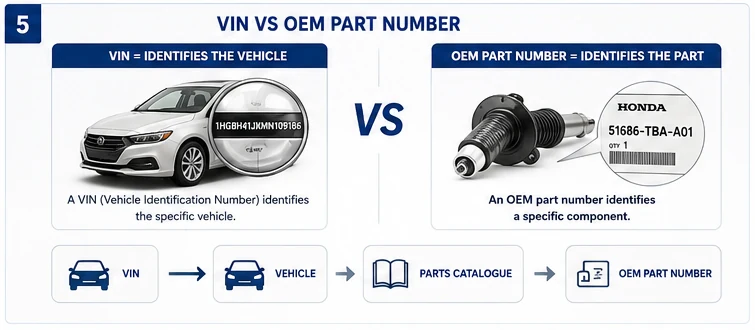
These two identifiers should not be confused
A VIN identifies a vehicle.
An OEM part number identifies a component.
The two work together.
A typical parts identification process looks like this:
VIN → Exact Vehicle → Manufacturer Parts Catalogue → OEM Part Number → Correct Replacement Part
If you already know the exact OEM part number, you may be able to skip much of this process.
If you do not know it, the VIN is often the best starting point for identifying the vehicle correctly.
A customer might ask for:
a shock absorber for a 2018 Honda Civic
That sounds reasonably specific.
But the vehicle may still have different components depending on:
Manufacturers can also change components during a model’s production run.
Two vehicles sold under the same model name and model year can therefore require different parts.
The OEM part number removes much of this ambiguity once it has been correctly identified.
If you already know the number, begin with the complete part number.
For example:
51686-TBA-A01
If results are limited, try adding the manufacturer:
Honda 51686-TBA-A01
You can also search without punctuation:
51686TBAA01
For another manufacturer:
Toyota 42410-30021
and
Toyota 4241030021
Using the manufacturer name together with the exact number helps distinguish automotive parts from unrelated products that may use similar numerical codes.
If you know that a part has been superseded, search both.
An older number can help locate:
The current number can help locate the manufacturer’s latest service replacement.
A good product database should ideally recognize relationships between previous and current numbers.
A photograph can help, but it should not normally be the primary identification method.
Many automotive components look nearly identical.
Differences may be difficult or impossible to see in photographs, including:
Photographs are most useful as an additional verification tool after identifying the part number and vehicle application.
There are several possible reasons
The original service number may have been replaced by a newer one.
The number printed on the component may belong to the company that physically manufactured it rather than the vehicle manufacturer.
The visible number may never have been used to sell the replacement component.
Characters such as:
0 and O
1 and I
5 and S
8 and B
can sometimes be confused on worn labels.
For older vehicles, the manufacturer may no longer supply the component.
Even then, the number remains valuable for searching old stock, cross-references and possible replacements.
Before ordering an expensive or difficult-to-replace component, check more than one piece of information whenever possible.
Do not ignore letters, prefixes or suffixes.
The same numerical sequence could potentially exist in unrelated catalogue systems.
Use the VIN to identify the exact vehicle when appropriate.
Confirm that the number is listed for the relevant vehicle specification.
Determine whether the original number has been replaced
For relevant components, confirm:
Check connectors, mounting points and other obvious physical characteristics as an additional verification
Automotive catalogues commonly use abbreviations such as:
LH — Left Hand
RH — Right Hand
These normally refer to the vehicle’s left and right sides when viewed from the driver’s normal forward-facing position.
Do not determine left and right by standing in front of the vehicle and looking toward it.
The same principle applies to descriptions such as:
FR — Front
RR — Rear
UPR — Upper
LWR — Lower
Understanding these abbreviations can help avoid ordering the correct type of component for the wrong side or position.
When buying genuine parts, the OEM number is one of the strongest identifiers available.
Product names can vary.
For example, essentially the same type of component might be described as:
Dust Cover
Shock Absorber Dust Cover
Strut Dust Boot
Suspension Dust Cover
Manufacturer catalogues themselves often use abbreviated descriptions.
The part number is much less ambiguous.
This is why a search for:
Honda 51686-TBA-A01
is generally more precise than:
Honda shock absorber dust cover
Aftermarket manufacturers frequently publish cross-reference information linking their products to OEM numbers.
For example:
Aftermarket Part XYZ
Cross-reference: Toyota 42410-30021
This can be useful when comparing replacement options.
However, a cross-reference should be checked carefully.
The fact that an aftermarket catalogue references an OEM number does not automatically establish compatibility with every vehicle on which that OEM number may appear without considering catalogue accuracy and application details.
For maximum confidence, use several identifiers together.
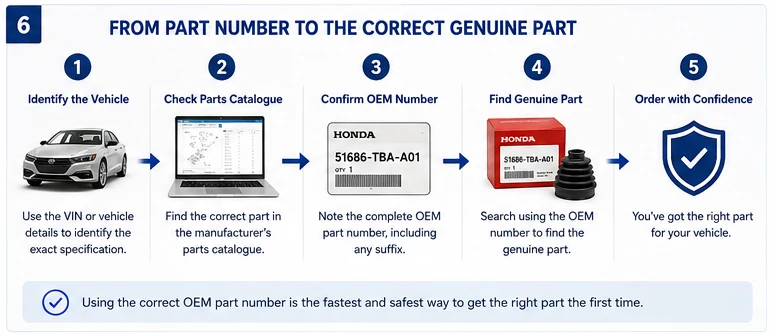
A good process is:
1. Find the vehicle VIN
2. Identify the exact vehicle specification
3. Locate the component in the manufacturer parts catalogue
4. Record the complete OEM part number
5. Check whether the number has been superseded
6. Confirm position, specification and relevant options
7. Search for the genuine replacement or a suitable alternative
This process is much safer than choosing a part based only on appearance or a generic vehicle description.
What is an OEM part number?
An OEM part number is a reference used in a vehicle manufacturer’s parts system to identify a particular component or component specification.
They are intended to distinguish parts within the relevant manufacturer’s catalogue system. Do not assume that a number is globally unique across every manufacturer and industry.
Yes. Manufacturers frequently share components across several models or vehicle configurations.
No. It may be a supplier number, casting number, engineering number, serial number or another production identifier.
It means an older service part number has been replaced in the manufacturer’s parts system by another number.
Yes. Searching both the old and current numbers can be useful.
Often they are simply different formatting of the same reference, such as 51686-TBA-A01 and 51686TBAA01. Always verify the complete number rather than relying only on formatting.
No. A small difference can identify a different specification or application.
Often, yes. The VIN can identify the exact vehicle, after which the appropriate manufacturer parts catalogue can be used to identify the required part number.
No. Photographs are useful for additional verification but should not replace part-number and vehicle-application checks.
A part number is much more than a stock code.
It provides a common reference between the vehicle manufacturer, parts catalogue, supplier, workshop and customer.
When correctly identified, it can turn a vague search such as:
“I need this suspension part for my Honda”
into a precise request:
“I need Honda 51686-TBA-A01.”
For anyone buying genuine replacement parts, learning to find and correctly use OEM part numbers is one of the simplest ways to reduce errors and find the right component faster.