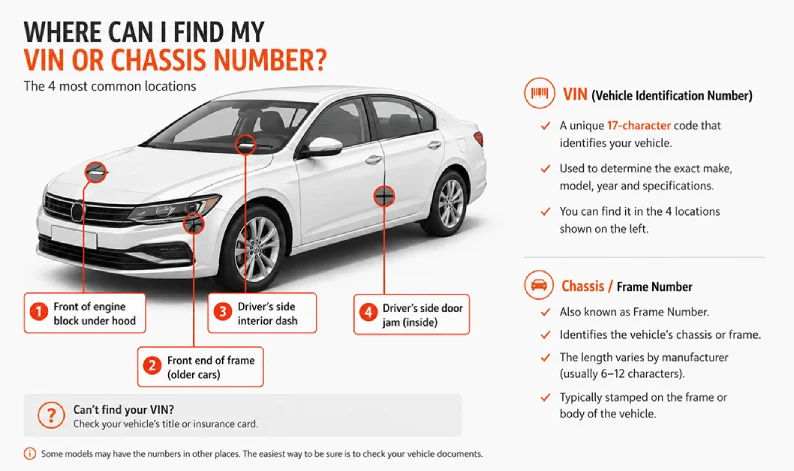
When replacing a part on your vehicle, you will often have two main choices: OEM or genuine parts and aftermarket parts.
Both can be suitable, but they are not the same. They can differ in fitment, quality, price, availability and warranty.
Understanding these differences can help you choose the right replacement part for your vehicle — without paying more than necessary or compromising where quality really matters.
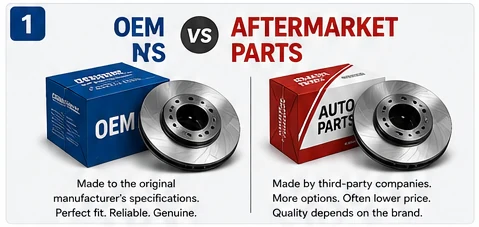
OEM stands for Original Equipment Manufacturer. In the automotive industry, OEM components are associated with the manufacturers and suppliers that produce parts to the specifications used in vehicle production.
You will also frequently see the term genuine parts.
A genuine part is normally supplied through the vehicle manufacturer's branded replacement-parts system. Examples include Genuine Toyota Parts, Genuine Nissan Parts, Genuine Honda Parts and Genuine Subaru Parts.
Genuine parts normally carry the vehicle manufacturer's official part number and are designed for specific vehicle applications.
This generally makes identification and fitment more predictable once the correct OEM part number has been established.
Aftermarket parts are replacement components sold outside the vehicle manufacturer's genuine parts system.
They are manufactured by independent companies and designed to replace original vehicle components.
The aftermarket ranges from inexpensive replacement parts to premium products made by highly respected specialist manufacturers.
Therefore:
Aftermarket does not automatically mean low quality.
Quality can vary significantly depending on the manufacturer, materials and product.
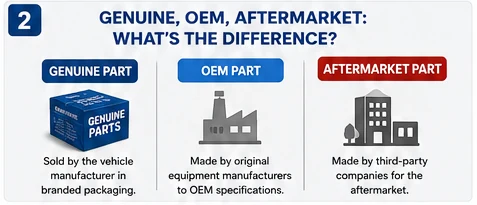
There are four major areas to consider.
Fitment
Genuine parts are catalogued for particular vehicle applications.
When the correct part has been identified using the VIN and manufacturer's parts catalogue, there is usually less uncertainty about fitment.
Aftermarket components are designed to replace one or more OEM applications. Fitment can be excellent, but accuracy depends on the manufacturer.
Quality
Genuine parts provide a relatively predictable specification and level of quality.
Aftermarket quality varies considerably. Premium aftermarket products can be excellent, while very inexpensive alternatives may use different materials or manufacturing tolerances.
Price
Aftermarket parts are often less expensive because multiple manufacturers compete to supply replacements for the same application.
Genuine parts are frequently more expensive, although this is not always the case.
The cheapest part is not necessarily the cheapest repair. If replacing a failed component involves several hours of labour, having to perform the repair twice can cost far more than the initial saving.
Choice
Once the correct genuine part number is identified, there is usually one manufacturer-specified replacement or an official superseding number.
For a common aftermarket component, there may be dozens of alternatives at different price and quality levels.
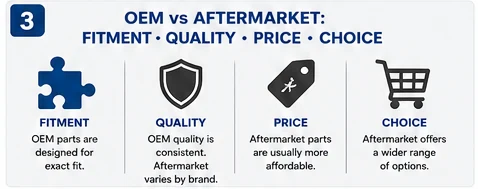
|
Feature |
Genuine/OEM |
Aftermarket |
|
Fitment |
Manufacturer-specified application |
Depends on manufacturer |
|
Quality |
Generally consistent |
Can vary considerably |
|
Price |
Often higher |
Often lower |
|
Choice |
Limited |
Usually much wider |
|
Availability |
Depends on genuine stock |
Often excellent for common parts |
|
Warranty |
Manufacturer/supplier terms |
Depends on brand |
|
Identification |
OEM part number |
Own number + OEM cross-reference |
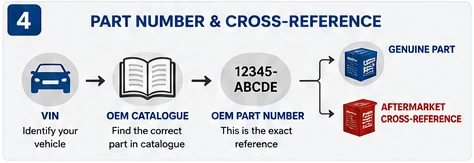
The OEM part number is useful regardless of which type of replacement you eventually buy.
For example:
Toyota 42410-30021
is a manufacturer's catalogue reference.
An aftermarket manufacturer may produce its own replacement with a completely different product number but list:
Cross-reference: Toyota 42410-30021
This allows you to start with the manufacturer's original reference and then compare genuine and aftermarket alternatives.
The ideal identification process is:
VIN → Vehicle → Manufacturer Catalogue → OEM Part Number → Replacement Part
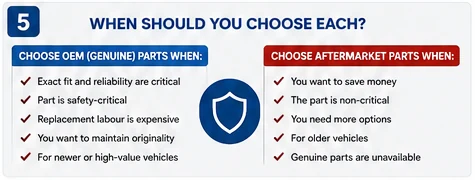
Genuine parts can be particularly attractive when:
They can be especially useful for specialised electrical components, sensors, switches, trim, model-specific hardware and other parts where small specification differences matter.
A reputable aftermarket product can make excellent sense when:
Filters, brake components, suspension parts, belts and many other common service items are available from established aftermarket manufacturers.
The important factor is who made the part and to what standard, rather than simply whether it is labelled aftermarket.
Aftermarket parts cannot be treated as one single quality category.
A decorative trim component and a steering component obviously do not carry the same consequences if they fail.
For safety-related components such as brakes, steering and suspension, quality and correct application should take priority over finding the lowest possible price.
Choose reputable manufacturers and verify that the component is intended for your exact vehicle application.
No.
A reputable aftermarket manufacturer can produce an excellent replacement, and some specialist aftermarket products are intentionally designed to offer different or improved characteristics.
The main advantage of genuine parts is predictability.
Once the correct OEM number has been identified, you know which replacement the vehicle manufacturer's catalogue specifies.
With aftermarket parts, you also need to evaluate the manufacturer and product quality.
Terms used in online listings can sometimes be confusing.
For example:
OEM replacement
OEM quality
OE equivalent
OEM style
do not necessarily mean genuine manufacturer part.
An aftermarket product described as:
"OEM replacement for Toyota 42410-30021"
may simply be designed to replace that Toyota part number.
If you specifically want a genuine part, check the manufacturer, packaging and complete OEM part number.
Whether you choose genuine or aftermarket, correct identification should come first.
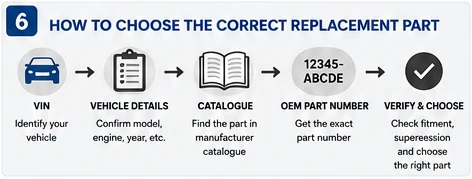
Use this process:
1. Find the vehicle VIN.
2. Confirm the exact model, engine and vehicle specification.
3. Find the component in the manufacturer's parts catalogue.
4. Identify the complete OEM part number.
5. Check whether the number has been superseded.
6. Compare suitable genuine and aftermarket options.
Do not rely only on photographs or a generic description such as "fits Honda Civic." The same vehicle model can use different components depending on engine, production date, market and specification.
Neither option is automatically right for every repair.
Choose genuine/OEM parts when exact specification, predictable fitment, originality and reducing uncertainty are priorities.
Choose a reputable aftermarket part when it provides good quality, correct compatibility and better value for your particular repair.
Most importantly, identify the component correctly before buying.
Your VIN identifies the vehicle.
The OEM part number identifies the part.
Together, they provide one of the most reliable ways to find the correct replacement component.
Are OEM and genuine parts the same?
Not always. Genuine parts are normally sold through the vehicle manufacturer's branded replacement-parts system. OEM can also refer to companies that manufacture original equipment for vehicle manufacturers.
Are aftermarket parts always cheaper?
Often, but not always. Premium aftermarket products can sometimes cost as much as genuine parts.
Are aftermarket parts lower quality?
Not necessarily. Quality varies by manufacturer and product, from budget components to premium specialist parts.
Can I use an OEM number to find an aftermarket part?
Yes. Reputable aftermarket catalogues commonly provide OEM cross-references.
How do I know which part fits my car?
The safest approach is to identify the vehicle using its VIN and then use the manufacturer's parts catalogue to determine the correct OEM part number.