A Vehicle Identification Number, commonly known as a VIN, is the unique identification code assigned to a vehicle by its manufacturer. On modern vehicles, the VIN normally consists of 17 letters and numbers and acts much like a fingerprint for the vehicle.
A VIN can identify the manufacturer and provide information about the vehicle’s characteristics, model year and production. It also distinguishes an individual vehicle from other vehicles of the same make and model.
VINs are used throughout a vehicle’s life — for registration, insurance, recalls, servicing, vehicle history, theft identification and, importantly, identifying the correct spare parts.
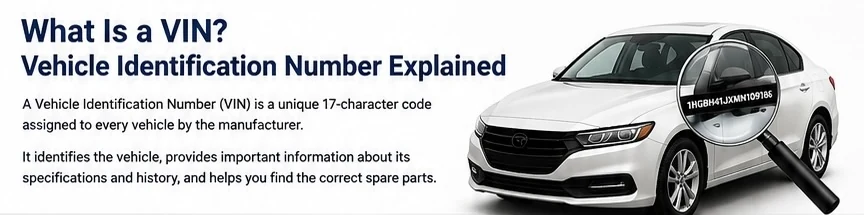
VIN stands for Vehicle Identification Number.
A modern VIN looks something like this:
1HGBH41JXMN109186
It may appear to be a random collection of letters and numbers, but it is actually divided into sections containing different types of information.
The VIN is assigned to the vehicle itself. Unlike a registration number or licence plate, which can change during the vehicle’s life, the VIN normally remains with the vehicle permanently.
International standards define the structure and content of vehicle identification numbers. ISO 3779 establishes the VIN content and structure used for worldwide vehicle identification.
The terms VIN and chassis number are often used interchangeably, particularly when ordering spare parts.
Historically, however, they are not exactly the same thing.
Before VINs were internationally standardized, vehicle manufacturers used their own chassis, frame or serial numbering systems. These numbers could differ greatly in length and format between manufacturers.
The modern VIN developed this idea into a standardized vehicle identification system.
For a modern passenger vehicle, when a dealer, workshop or parts supplier asks for the chassis number, they will usually be asking for the vehicle’s VIN.
Older and specialist vehicles may use different identification systems, so this distinction can still be important.
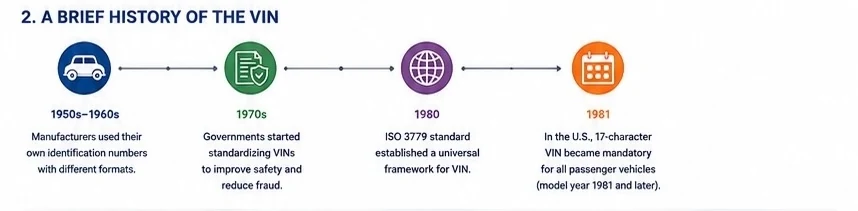
Vehicle manufacturers have used serial and chassis numbers for many decades.
During the 1950s and 1960s, however, there was no single standardized VIN format. Different manufacturers could use different numbering systems, different lengths and different methods of encoding vehicle information.
This became increasingly inconvenient as the automotive industry grew.
Governments, manufacturers, insurers and law-enforcement authorities needed a reliable way to distinguish one vehicle from another.
Vehicle identification became particularly useful for:
During the 1970s, vehicle identification requirements became increasingly standardized.
ISO adopted the World Manufacturer Identifier standard in 1980, while modern VIN requirements in the United States introduced the familiar 17-character format for vehicles beginning with the 1981 model year. NHTSA describes the VIN as a cornerstone of its safety-defect and recall system.
The result is the VIN system that we recognize today.
A modern VIN uses 17 characters because the characters are divided into sections with different purposes.
Broadly, the VIN contains:
|
Positions |
Section |
Purpose |
|
1–3 |
WMI |
Identifies the manufacturer |
|
4–8 |
VDS |
Describes vehicle characteristics |
|
9 |
Check digit in some systems |
Helps verify the VIN |
|
10–17 |
VIS |
Identifies model/production information and the individual vehicle |
The precise information encoded in some positions varies according to manufacturer and regulatory system, so a VIN should not be decoded using a single universal table for every vehicle in every market.
The first three characters are commonly known as the World Manufacturer Identifier, or WMI.
This section identifies the vehicle manufacturer and related manufacturing information.
For example, different manufacturers and production locations receive different identifiers, allowing the beginning of a VIN to help establish who manufactured the vehicle
For high-volume manufacturers, the first three positions serve as the manufacturer identifier.
Positions 4 through 8 form the Vehicle Descriptor Section, or VDS.
Manufacturers use this section to encode characteristics of the particular type of vehicle.
Depending on the manufacturer, these positions may relate to characteristics such as:
There is no safe universal rule such as “character 6 always means the engine” for every vehicle manufacturer worldwide.
Manufacturers define their own codes within the applicable VIN standards and regulations. NHTSA, for example, requires manufacturers to submit information that allows the agency to decipher their VINs.
In VIN systems such as that used in North America, position 9 contains a check digit.
It is calculated mathematically using the other characters of the VIN
Its purpose is not to describe a component of the car. Instead, it helps determine whether a VIN has been entered or transcribed correctly.
A mistyped character can cause the mathematical validation to fail.
In the North American VIN system, the 10th character identifies the vehicle’s model year.
Letters and numbers are assigned to model years according to an established sequence.
However, the codes eventually repeat, so the 10th character should be interpreted together with the rest of the VIN and information about the vehicle.
It is also important not to assume that every vehicle in every world market follows precisely the same decoding rules.
Under the U.S. VIN structure, the 11th position identifies the plant of manufacture
The meaning of the particular letter or number is defined by the manufacturer.
For large manufacturers under the U.S. system, the final six characters provide the sequential production identification for vehicles within the relevant manufacturing group.
This helps distinguish the individual vehicle from otherwise similar vehicles.
The VIN therefore identifies not merely a model such as a Honda Civic or Toyota Land Cruiser, but a particular vehicle.
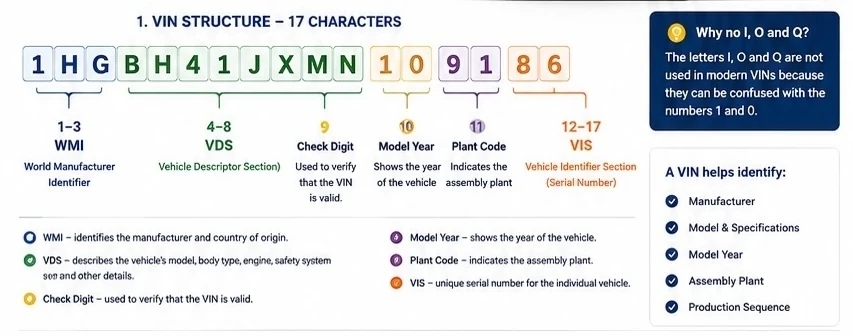
Modern 17-character VINs do not use the letters I, O or Q.
The reason is simple: they can easily be confused with numbers.
I can look like 1.
O and Q can look like 0.
Excluding these characters reduces the risk of transcription errors. NHTSA documentation for post-1980 vehicles explicitly notes that VINs must not contain I, O or Q.
Depending on the manufacturer and market, decoding a VIN can reveal or help determine information including:
The exact information available varies.
A VIN should therefore be regarded as a structured vehicle identifier rather than a universal specification sheet in which every character always means the same thing.
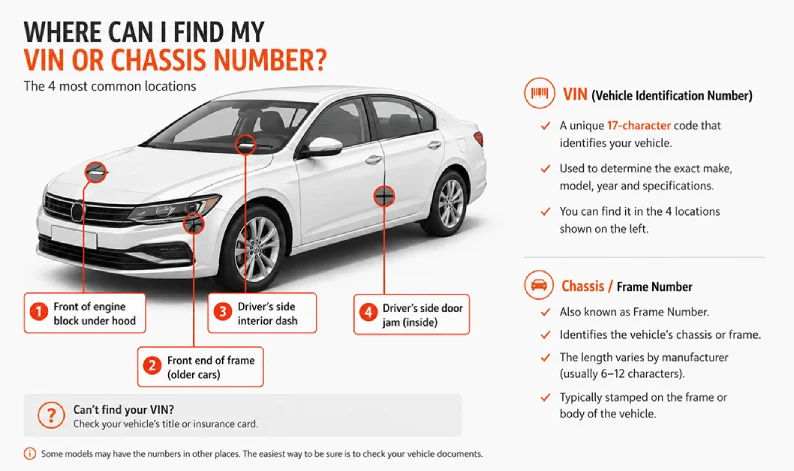
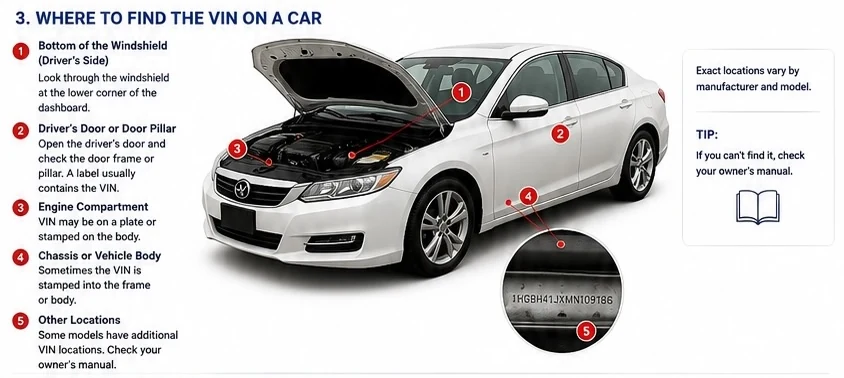
Manufacturers usually make the VIN available in more than one location.
The exact location varies by vehicle, but there are several common places to check.
One of the easiest places to look is the lower part of the windshield on the driver’s side.
On many vehicles, a small VIN plate is positioned on top of the dashboard so that the number can be read through the windshield from outside the car.
Open the driver’s door and inspect the door frame and pillar
Many manufacturers place an identification label in this area.
The label may contain the VIN together with other information such as:
The exact information varies between manufacturers.
Depending on the manufacturer and vehicle, identification information may also be located in the engine compartment.
The VIN may be stamped directly into part of the vehicle body or displayed on an identification plate.
Some vehicles have the identification number permanently stamped into the body, frame or chassis.
The precise position is manufacturer- and model-specific.
Some manufacturers use additional or concealed VIN locations for identification and anti-theft purposes.
If you cannot locate the VIN, consult the vehicle owner’s manual or manufacturer information for the particular model.
You do not necessarily need to be standing next to the vehicle to find its VIN.
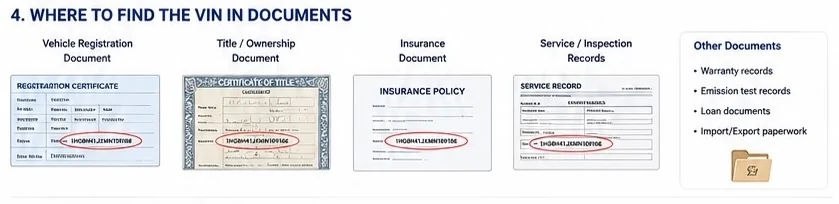
The number is commonly recorded in vehicle-related documentation.
Depending on the country, this can include:
The VIN or chassis number is normally recorded on the official registration document.
In countries that issue a vehicle title, the VIN is normally included as one of the principal identifiers.
Insurance policies and certificates frequently include the VIN because it identifies the exact insured vehicle.
Technical inspection and roadworthiness documentation may include the VIN.
Dealers and workshops often record the VIN when creating service or repair records.
Original sales documentation, warranty records and dealer service histories may also contain the VIN.
The VIN has many purposes throughout the life of a vehicle.
Registration authorities use the VIN to associate records with the exact vehicle rather than merely its make, model or licence plate.
Insurers can use the VIN to identify the precise vehicle being insured and obtain information about its specification.
VINs are important in determining whether an individual vehicle falls within the production range affected by a safety recall.
NHTSA describes vehicle identification as fundamental to effective identification of vehicles and manufacturers for safety defects and noncompliance recalls.
The VIN helps police and other authorities identify vehicles and certain major components
Vehicle identification requirements have historically been important both for recalls and for investigating vehicle theft.
Vehicle-history systems can associate events with a VIN, potentially including registration history, accidents, inspections, mileage records and other events where such data is available.
VINs are used to identify vehicles in customs, import, export, homologation and registration procedures.
Workshops can use the VIN to identify the exact vehicle specification before ordering parts or performing manufacturer-specific procedures.
For Global Parts customers, this is one of the most important uses of the VIN.

Knowing the make, model and year of a vehicle is not always enough to identify the correct replacement part.
Consider two cars that appear to be identical.
They may have been built:
Those differences can result in different OEM part numbers.
This is why professional parts catalogues frequently start with exact vehicle identification.
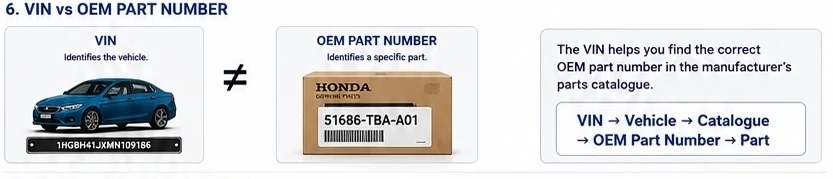
A VIN and an OEM part number are not the same thing.
A VIN identifies the vehicle.
An OEM part number identifies a particular component.
For example, the identification process may look like this:
VIN → Exact Vehicle → Manufacturer Parts Catalogue → OEM Part Number → Correct Part
The VIN helps establish exactly which vehicle you have. The manufacturer’s parts catalogue can then be used to determine which part numbers apply to that vehicle.
Not always.
A VIN is an extremely useful starting point, but it is not a complete list of every component installed on a vehicle
Depending on the vehicle and component, correct identification may also require:
There can also be multiple valid part numbers because manufacturers revise components over time.
An original number may have been replaced by a newer superseding part number.
Automotive production changes continuously.
A manufacturer can introduce a revised component during a model’s production run without changing the vehicle’s commercial model name.
For example:
Model A — January production → Part 12345-A
Model A — September production → Part 12345-B
Both cars may be advertised as exactly the same model and model year.
The VIN and associated production information help distinguish between them.
This is one reason why searching for parts only by make, model and year can sometimes produce incorrect results.
For accurate part identification, provide as much of the following information as possible:
If you already know the exact OEM part number, searching directly by that number can often be the fastest way to find the part.
A VIN is intentionally visible on many vehicles and appears on numerous official records. It is fundamentally a vehicle identifier rather than a password or security credential.
Nevertheless, it is sensible to consider where and why you are publishing any vehicle information online, particularly when it is combined with ownership records or other personal information.
For a parts enquiry, providing the VIN directly to a reputable parts supplier or workshop is a normal way to help identify the vehicle.

The most useful way to think about the relationship between a VIN and spare parts is:
The VIN tells us which vehicle we are dealing with.
The parts catalogue tells us which components belong to that vehicle
The OEM part number tells us exactly which replacement component we need.
This distinction is particularly important with genuine automotive parts, where visually similar components can have different specifications and different OEM numbers.
What does VIN stand for?
VIN stands for Vehicle Identification Number.
How many characters does a VIN have?
A modern standardized VIN normally contains 17 characters. Older vehicles may use shorter manufacturer-specific chassis or serial numbers.
Is the chassis number the same as the VIN?
For many modern vehicles, the terms are used interchangeably. Historically, chassis numbers existed before the standardized modern VIN system, so they are not always technically identical.
Where is the VIN located?
Common locations include the lower driver’s side of the windshield, driver’s door pillar, engine compartment and a permanent stamping on the body or chassis.
Where can I find the VIN in my documents?
It can normally be found on the vehicle registration document and may also appear on title/ownership documents, insurance records, inspection documents and service records.
Can I determine the model year from a VIN?
In VIN systems such as the North American system, the 10th character identifies model year. VIN interpretation can vary by regulatory market and manufacturer.
Why does my VIN not contain I, O or Q?
These letters are excluded from modern 17-character VINs because they can easily be confused with 1 and 0.
Can a VIN help identify the correct spare part?
Yes. The VIN can be used to identify the exact vehicle specification, which can then be checked against the appropriate manufacturer parts catalogue.
Is the OEM part number contained directly in the VIN?
No. The VIN identifies the vehicle; it does not contain a list of its OEM part numbers.
Why does my pre-1981 vehicle have a shorter VIN?
Older vehicles can predate the modern standardized 17-character VIN system and may use manufacturer-specific chassis or serial numbers.
From VIN to the Correct OEM Part
Correct spare-part identification is especially important when buying genuine components.
Whenever possible, use the following process:
1. Identify the VIN
Find the complete VIN on the vehicle or its official documents.
2. Identify the Exact Vehicle
Confirm the correct model, production details and specification.
3. Check the Manufacturer Parts Catalogue
Use the vehicle information to locate the required component.
4. Confirm the OEM Part Number
Check the complete part number, including any suffix or supersession.
5. Search for the Genuine Part
Use the confirmed OEM number to locate the correct replacement.
This approach is considerably safer than choosing a component simply because it looks similar to the one installed on the vehicle.